field worker accountability
Field Worker Accountability: A Manager's Practical Guide
Build field worker accountability with clear expectations, outcome measures, verified time records and fair coaching. A practical guide for managers of field teams.
Build field worker accountability with clear expectations, outcome measures, verified time records and fair coaching. A practical guide for managers of field teams.
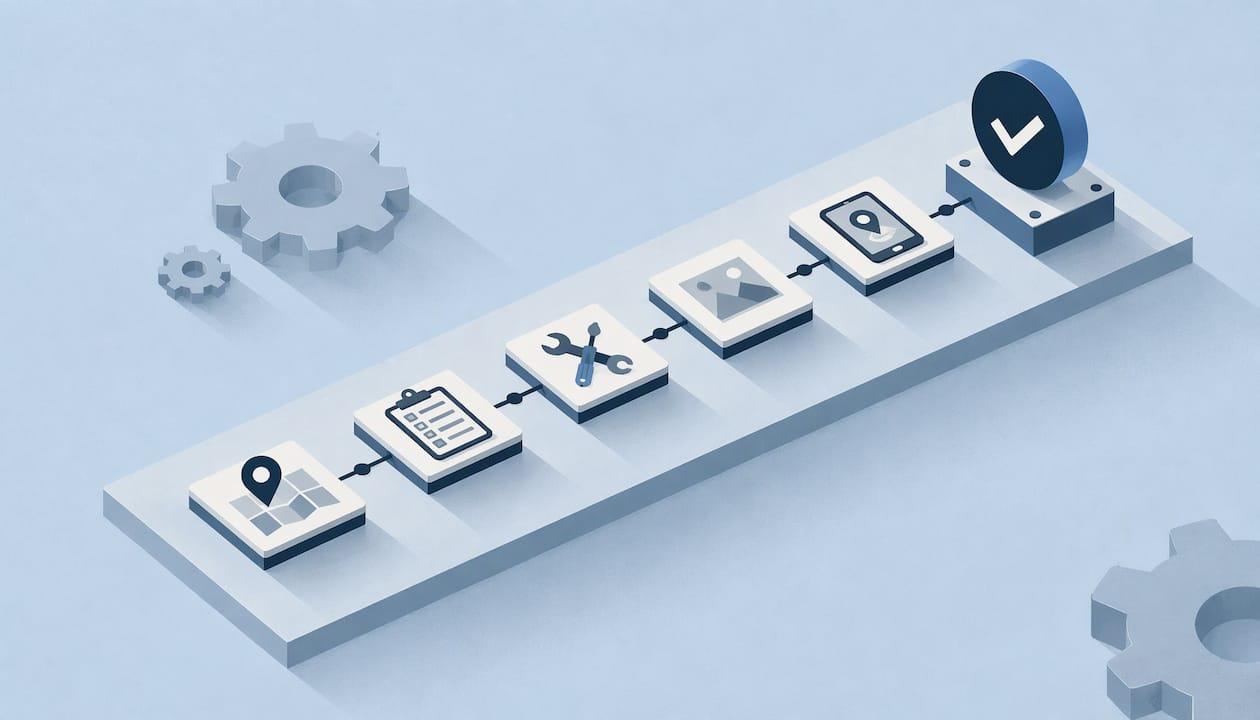
Field worker accountability comes from three things working together: clear expectations, outcome-based measures, and time records you can trust. You can’t watch a crew all day, and you shouldn’t try. You agree on what “done” looks like, verify where and when work started, and follow up fast when something slips. This guide shows you how to set that up, step by step.
Accountability is the habit of owning your work and its results. The U.S. Office of Personnel Management describes five core principles of employee accountability: responsibility, transparency, follow-through, problem ownership and feedback acceptance. Each one has a plain field version:
Notice what is missing from that list: being physically visible. University HR guidance on managing remote employees makes the same point for remote work. Being at a computer is attendance. Performance is better judged against predetermined metrics and feedback tied to quality and timely delivery. The same logic holds for a roofing crew, a home-care visit or a delivery route. Presence matters because it is the start of the work, and outcomes are what you actually hold people to.
Office managers see who arrived. Field managers see a phone number and a job ticket. That gap creates three recurring problems:
Every one of these weakens accountability. When honest employees see others get away with loose time records, they stop trusting the system. When managers can’t trust the records, they fall back on suspicion and check-in calls, which wears everyone down.
People can’t be accountable for things nobody defined. Guidance for managers of remote staff says to clarify at the outset how work will be performed, delivered and reviewed, how tasks that can’t be done remotely are handled, how team communication works, and how confidential information and company property are protected. For a field team, translate that into a one-page working agreement.
Cover these points and have every crew member acknowledge them:
Keep it short. A page people read beats a binder they don’t.
A dispersed-team guide from the Australian government recommends agreeing on quantifiable performance measures, such as projects completed on time, client satisfaction and support for team goals, and updating performance plans to match. It also stresses consistent communication processes and regular check-ins. Australia’s rules differ from U.S. rules, but the management principle carries over directly.
For field work, good measures look like this:
| Role | Outcome measure | Time-record measure |
|---|---|---|
| Installer | Jobs completed per week without callbacks | On-site start within the scheduled window |
| Home-care aide | Visits completed with notes filed same day | Verified arrival and departure per visit |
| Delivery driver | Stops completed on schedule | Shift start at the depot, shift end logged |
| Inspector | Reports submitted within 24 hours | Verified presence at each inspection site |
The left column is what the customer cares about. The right column is the evidence that supports payroll and compliance. You need both, and neither should be the whole picture.
Accountability for outcomes sits on top of accurate time and attendance data. Without it, you can’t tell a scheduling problem from a performance problem. You also can’t pay people correctly.
The law cares too. Under the federal Fair Labor Standards Act, covered employers must keep records for each non-exempt worker, and the Department of Labor’s recordkeeping fact sheet says no particular form is required but the information must be accurate. The department’s FLSA Handy Reference Guide lists the required items, including when the workweek begins, total hours worked each workday and each workweek, straight-time earnings, overtime pay and the dates of payment.
California is stricter on detail. The state’s Division of Labor Standards Enforcement describes Labor Code Section 1174: employers keep accurate records of time worked by non-exempt employees, showing when each work period begins and ends, meal periods, split shift intervals and total daily hours. Payroll records are kept for three years, and employees must be able to inspect or copy their records under Labor Code Section 226(a). If you have crews in California, a vague “about eight hours” entry is a liability. Other states have their own rules, so check your state labor department for local requirements.
The goal is a record that answers four questions for every shift: who worked, where they started, when they started and stopped, and who approved it. Here is a practical way to get there.
Buddy punching works when a punch can be made by anyone holding a device or knowing a PIN. Close that gap with identity verification at clock-in, so the punch belongs to the person it says it does. Device-based fraud detection adds another layer by flagging punches that don’t match a worker’s usual device pattern.
A geofence is a virtual boundary around a job site. When the punch has to happen inside it, “I was there” becomes a verified fact. Random location check-ins at clock-in time mean you don’t need continuous background tracking to know a shift started where it should. We cover the approach in more detail in our guide to field employee location verification, and in our piece on GPS time tracking benefits for field managers.
If clocking in is annoying, people skip it and fill in times later. A single tap on a phone, with no paper timesheets, removes the excuse and the transcription errors that follow. Fewer steps also means fewer “I forgot” corrections for you to chase.

At the end of the pay period, have each employee confirm their own timecard. Attestation turns the record into a shared statement. If a person agrees that the hours are right, disputes get rarer and easier to settle. It also supports the California requirement that records be accurate.
Managers review exceptions, approve timesheets and send clean data to payroll. When approval is routine and fast, small errors are fixed within days, not discovered months later.
Verified data helps accountability only if employees understand it. Heavy-handed monitoring breeds resentment, and resentment hurts the performance you’re trying to improve. Follow these ground rules:
Transparency also protects honest employees. A verified record is the best defense when someone says they didn’t work an hour they did.
Tools support accountability, but the underlying workflow decides whether it sticks. Clear handoffs, named owners and visible status help every crew member see what is expected. For a broader view of how structured processes raise visibility in larger organizations, see this overview of advanced workflow management for enterprises. For maintenance-style work, auditable work order states show how defining each stage of a job makes ownership obvious.
The same idea applies to a field crew. Every job has an owner, a status and a verified start. When something goes wrong, you know who to call and what happened, without a blame hunt.
Even with great systems, someone will miss a punch, arrive late or leave a job incomplete. How you respond decides whether accountability becomes a culture or a threat.
Pennsylvania’s state HR training on addressing performance deficiencies tells supervisors to address problems as they occur, document them before speaking with the employee, counsel the employee on the gap and ways to improve, then build an action plan with progress reviews. Waiting for an annual review is too slow for field work.
Verified timestamps make step 2 easy. You aren’t arguing about memory. You’re looking at the same record the employee attested to.
When you want to recognize it, look for the behaviors OPM’s guide describes: knowing the role, tasks and key performance indicators, tracking progress regularly, flagging problems early instead of at the deadline, and admitting mistakes quickly with a plan to fix them. Name these in team meetings. Praise a technician who reports a delay at 8:30 a.m. People repeat what gets noticed.
Our perspective
We built Clock-Me around one belief: accountability should feel fair to the people doing the work. Most field employees are honest. What frustrates them is a system where a few shortcuts make everyone look suspect, or where paper timesheets get lost and hours get disputed.
That’s why we combine GPS-verified punches, identity checks that block buddy punching, and geofencing in a single tap. Our approach doesn’t rely on paper timesheets or continuous background tracking. Managers get live dashboards and the facts they need. Employees get a simple, clear record of their own day.
We also designed the platform with California labor law compliance features, because accurate records protect both sides. Our timecard attestation lets employees confirm their hours, so approvals and payroll start from agreed facts.
Accountability then becomes a conversation about results, not a debate about whether someone showed up.
Clock-me
A good system fits how your crews actually work. Look for these capabilities:
If you’re comparing options, browse our articles on GPS time tracking and employee attendance systems for more detail.
Clock-Me is our workforce management platform for teams in the field. Plans are priced by the number of active employees, and small teams can start free. Published monthly prices on our plans page are:
| Plan | Price per month |
|---|---|
| Free | $0 |
| Starter | $31.99 |
| Growth | $54.99 |
| Business | $99.99 |
| Pro | $224.99 |
| Corporate | $439.99 |
| Enterprise | Contact us |
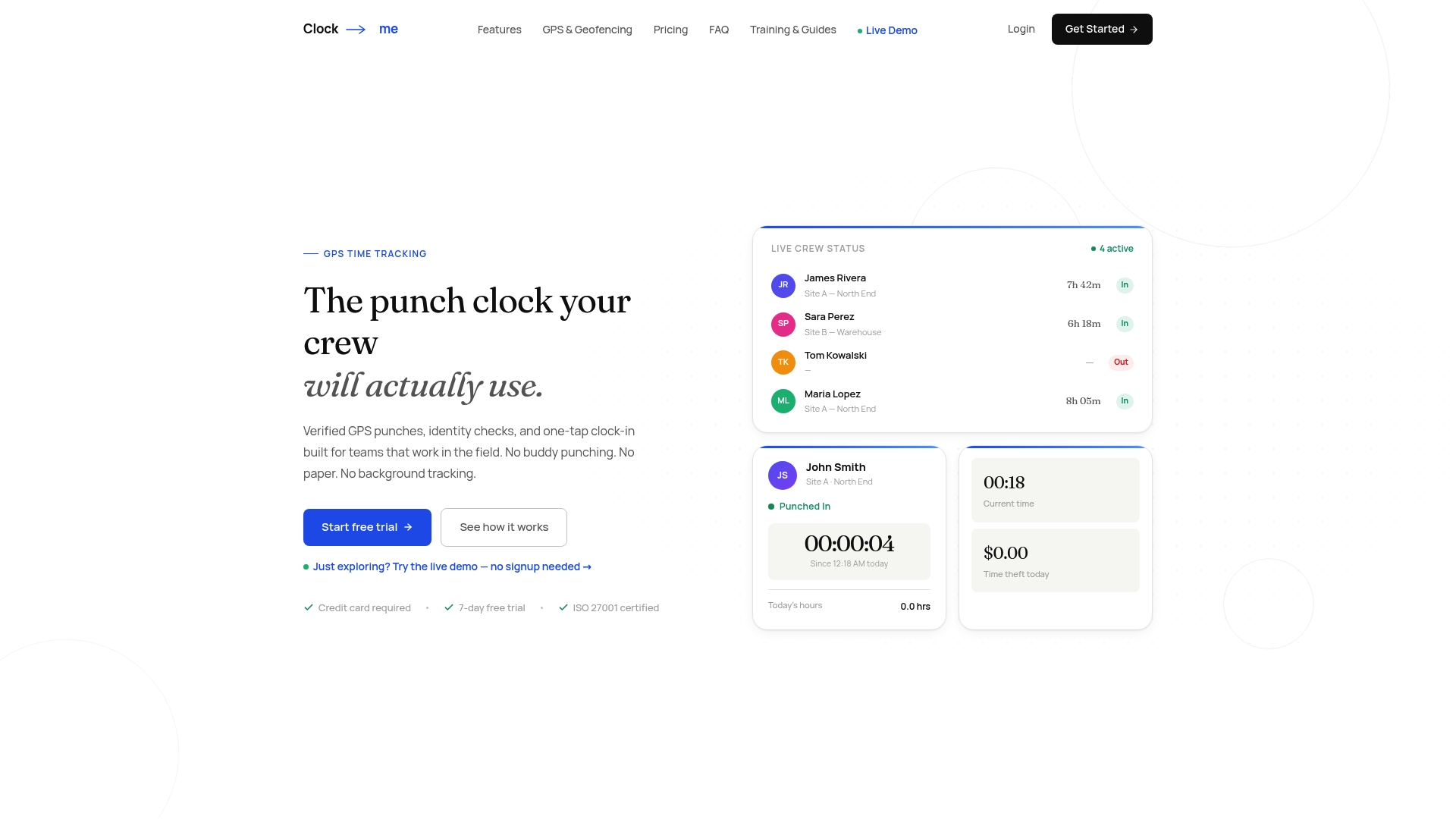
Start on the Free plan, set up one crew and one job site, and see verified punches on your live dashboard. When you’re ready for more employees, upgrade without changing how your team clocks in. Visit Clock-Me to get started.
Changes stick when you introduce them in stages.
Week 1: Define. Write the one-page field agreement. Choose two or three outcome measures per role. Decide what counts as the start of a shift at each job site.
Week 2: Pilot. Pick one crew. Set up their job sites and geofences, and walk them through the one-tap clock-in. Explain what location data is collected and why.
Week 3: Review. Check the dashboard daily for exceptions. Fix setup problems quickly, such as a geofence that’s too small. Hold a short huddle to hear what’s confusing.
Week 4: Expand. Add the remaining crews. Turn on weekly attestation and set a standard approval day. Schedule a monthly review of attendance and outcome measures with each supervisor.
After the first month, the pattern is routine: verified punches, weekly attestation, approval, export, and a brief coaching conversation whenever the data shows a gap.
Agree on clear duties and measurable outcomes, then verify the basics: where and when work started. Add regular check-ins and prompt coaching when something slips. Guidance for remote teams says to judge performance against predetermined metrics, not visibility.
A field employee does most of their work away from a central office, such as at customer homes, job sites or on the road. Examples include installers, inspectors, drivers and home-care aides. Whether they are paid hourly or exempt depends on the job and the law, so confirm classification with your state labor department or an employment attorney.
Require identity verification at every clock-in and tie the punch to a job site location. Device-based fraud detection adds another check. Together these make a punch belong to one person in one place, which is what a trustworthy time record needs.
Federal rules require accurate records of hours worked each day and week for non-exempt employees, as the Department of Labor explains. California adds detail on meal periods, split shifts and a three-year retention period, per the state’s guidance.