off the clock work laws
Off-the-Clock Work Laws: What Employers and Employees Must Know
Federal and California off-the-clock work laws explained: when unpaid work is illegal, what records employers must keep, and how to recover unpaid wages.
Federal and California off-the-clock work laws explained: when unpaid work is illegal, what records employers must keep, and how to recover unpaid wages.
Working off the clock, meaning doing work that is not recorded or paid, is generally illegal for nonexempt employees in the United States. Under the federal Fair Labor Standards Act (FLSA), work an employer requires or permits counts as hours worked and must be paid, including overtime at one and one-half times the regular rate after 40 hours in a workweek. California adds its own record and pay rules on top. This guide covers what the law says, where employers get into trouble, and how to keep clean records.
Off-the-clock work is any work done outside scheduled or recorded paid hours, for which the employee receives no pay. The U.S. Department of Labor (DOL) describes hours worked broadly. Examples in its guidance include finishing an assigned task after a shift ends, correcting errors, and periods when an employee is engaged to wait.
In practice it shows up in familiar ways:
Field crews are especially exposed. Drivers, installers, inspectors and cleaners often start work at a job site, not at a central office. When a shift’s start and end are guessed after the fact, minutes slip away.
For nonexempt employees, yes in most cases. The FLSA requires covered nonexempt workers to receive at least the federal minimum wage of $7.25 per hour and overtime of at least 1.5 times the regular rate for hours over 40 in a fixed seven-day workweek. Weekends, holidays and days off do not trigger overtime on their own. The 40-hour threshold does.
The key phrase is “suffer or permit.” The DOL’s elaws advisor explains that if an employee keeps working and the employer knows or should know about it, the time is generally compensable. An employee who skipped prior authorization does not erase that duty. Management knew or should have known is what matters.
What does that mean for each side?
Generally no. DOL guidance says employees cannot simply volunteer to do their jobs without the time being counted. Employees also generally cannot waive their FLSA pay rights, according to DOL Field Assistance Bulletin 2020-5. So a signed note saying “I agree to work unpaid” does not fix the problem.
Yes, and it should have a clear policy. But a policy alone is not a defense. The DOL says management must exercise control to prevent unwanted work and cannot accept the benefit of the work without counting the time. The sound approach is to pay for all time worked and address the unauthorized overtime through coaching or discipline, not by withholding pay.
Break rules are where many off-the-clock disputes start. Under the FLSA, bona fide meal periods, typically 30 minutes or more, generally do not need to be paid, but only when the employee is completely relieved from duty. If a worker eats at a desk while answering the phone, or is interrupted to handle a customer, that period is not a true meal break.
Short rest periods, usually 20 minutes or less, generally must be counted as paid work time.
A quick test for any unpaid break:
If any answer is no, treat the time as hours worked.
The same principle applies when work happens at home. DOL Field Assistance Bulletin 2020-5 says employers must pay for all hours worked, including unscheduled home work, when they know or have reason to believe it occurred. A reasonable procedure for reporting unscheduled time can help an employer show reasonable diligence. But reported time must still be paid, and a process that prevents or discourages accurate reporting is inadequate.
That last point matters for managers. If supervisors roll their eyes when someone reports 20 extra minutes, employees will stop reporting. The employer still owes the wages.
Federal law does not tell you which tool to use. It tells you what the record must contain. Under the DOL’s Handy Reference Guide, FLSA employers must keep records of employee identity, workweek start, hours worked each day and week, straight-time earnings, regular rate when overtime is worked, overtime pay, wage adjustments, total wages, payment date and the covered pay period.

Federal rules do not require a particular timekeeping method. Employers may use a time clock or employee self-reporting if the records are complete and accurate. Payroll records generally should be kept for at least three years, while wage-calculation records such as time cards and schedules generally should be kept for two years. For a closer look at retention periods, see our guide to timecard retention requirements.
A tool that lets people reconstruct their hours days later usually produces records that are neither complete nor accurate. Timestamps captured at the moment of work are far easier to defend.
California employees get the federal protections plus state rules. Here is what the state’s official sources say.
California Labor Code section 226 requires itemized wage statements showing gross wages, total hours worked, deductions, net wages, pay-period dates, employer identity, applicable hourly rates and hours at each rate. The employer must retain the statement and deduction record for at least three years. If off-the-clock time never enters the system, the wage statement cannot show it, which is why unrecorded work creates a second problem on top of the unpaid wages.
California’s Department of Industrial Relations (DIR) guidance says employers must keep nonexempt employees’ time records showing when each work period begins and ends, meal periods, split-shift intervals and total daily hours. Meal periods during which operations cease and authorized rest periods need not be recorded. DIR says payroll records must generally be retained for three years.
Employees who show up and are sent home early may be owed pay for time they did not work. California’s reporting-time rules can require half the usual or scheduled day, but at least two and no more than four hours, when an employee reports and receives no work or less than half a scheduled day. A second report on the same day can require two hours if less than two hours are provided. Field managers who cancel jobs on arrival should check this rule before sending a crew home.
| Topic | Federal (FLSA) | California |
|---|---|---|
| Pay for work the employer knows about | Required | Required |
| Record of daily start and end of work periods | Hours worked each day and week | Start and end of each work period, meal periods, split-shift intervals, total daily hours |
| Payroll record retention | Generally three years | Generally three years |
| Wage claim window | Generally two years, three if willful | Generally three years for many claim types |
| Itemized pay statement | Not covered in the same form | Labor Code section 226 |
When both laws apply, employers should plan around whichever is more protective for the employee.
The remedies under the FLSA include DOL-supervised back wages, a lawsuit by the Secretary of Labor for back wages and an equal amount of liquidated damages, or a private lawsuit for back pay, equal liquidated damages, attorney’s fees and court costs, generally subject to a two-year limit, or three years for willful violations. In plain terms, unpaid wages can double, and legal costs can land on the employer.
The practical cost is often bigger than the wages. Small unpaid amounts repeated across a whole crew for years add up, and records that cannot show actual hours leave the employer with little to defend itself.

If you think you have worked unpaid time, start documenting now.
For advice on a specific dispute, talk to the DOL Wage and Hour Division, the California DLSE, or an employment attorney.
Prevention comes down to pay policy, manager behavior and records you can trust.
State that all time worked is paid, that work needs approval ahead of time when possible, and that unapproved work will be paid and then addressed. Because the DOL expects management to exercise control, a policy that is never enforced offers little protection.
If workers must hunt down a supervisor to add 15 minutes, many will not bother. Give them a simple way to flag time, and never discourage it. Planning calendars help too: a shared work calendar keeps scheduled blocks visible so supervisors can compare planned jobs with the hours actually recorded.
Off-the-clock minutes often hide the 40-hour mark. Alerts that fire as employees approach overtime let you reassign work before the week runs over. Our post on overtime alerts at 40 hours walks through setting those rules.
A record made on the spot is more reliable than one rebuilt on Friday. For a step-by-step approach, see our guide to audit-ready FLSA timekeeping.
Look for patterns: punches that always land at exactly the scheduled minute, early arrivals with no punch, and employees who regularly answer messages after hours. Pay what is owed, fix the cause, and keep notes on what you changed.
Most off-the-clock problems are not caused by bad intentions. They come from time records that are hard to fill in, hard to trust or hard to correct. A crew member finishes a job, drives to the next site and forgets to punch out. A supervisor guesses the time on Friday. Neither is trying to cheat anyone, but the record is wrong.
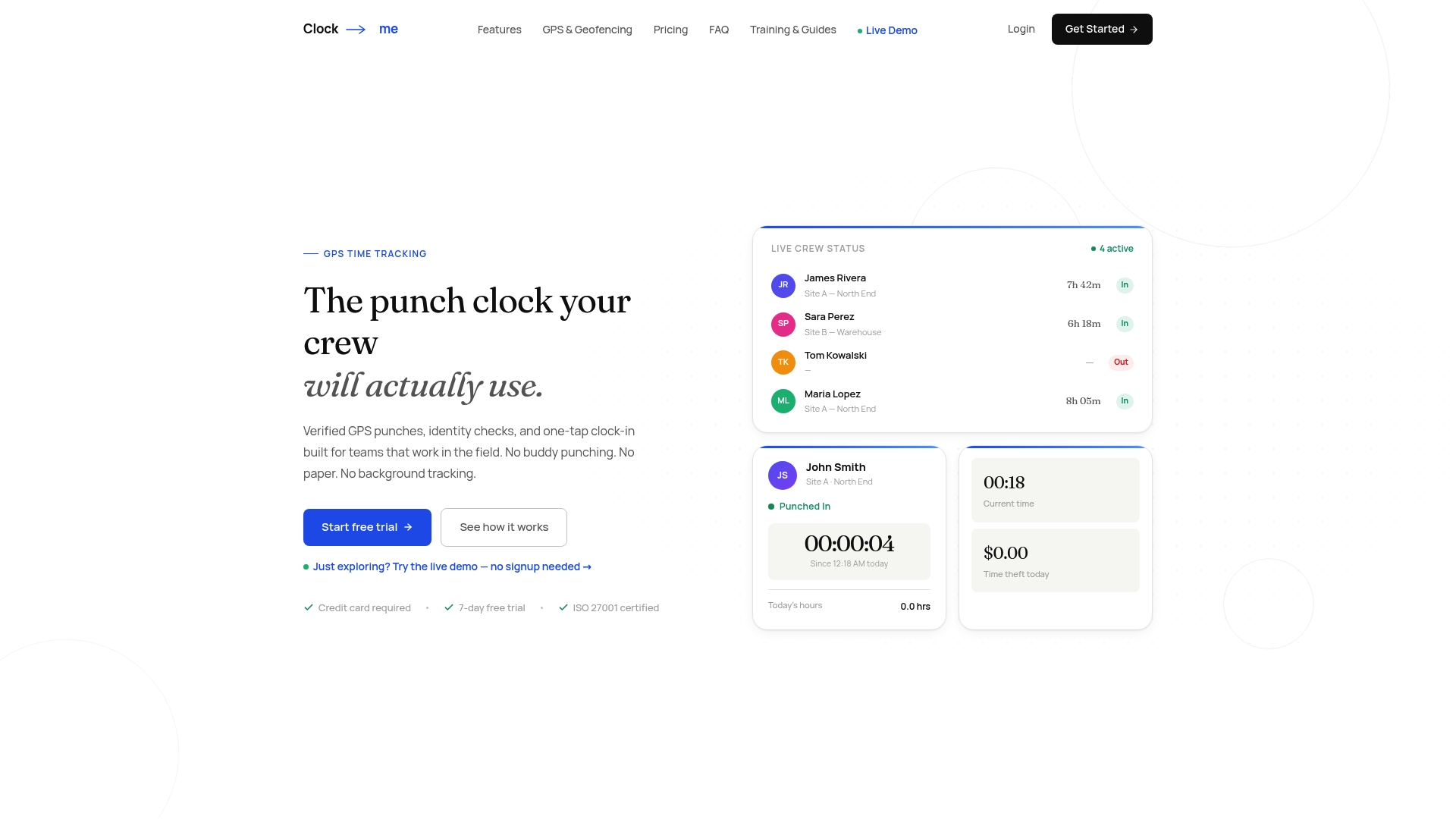
We built Clock-Me around a simple idea: capture the punch when the work happens, and make sure it is a real punch. Verified GPS clock-ins, identity checks and geofencing tie each entry to a person and a place, so the hours on the timecard match what happened in the field. Because the platform is designed without paper timesheets and without continuous background tracking, it stays simple for employees to use.
For managers, live dashboards show who is on the clock right now, and timecard attestation lets employees confirm their hours before approval. We also include California labor law compliance features and bilingual support content, because the teams that need accurate records most are often the ones working across languages and job sites.
Good records protect both sides. Employees get paid for the time they work, and employers have a clear, timestamped answer when someone asks about it.
Clock-me
Clock-Me gives field teams a one-tap clock-in that is verified by GPS and identity checks, with geofencing, random location check-ins, live dashboards, timecard attestation, timesheet approval and payroll export in one platform. You can start on the Free plan at $0 per month. Paid plans start with Starter at $31.99 per month, then Growth at $54.99, Business at $99.99, Pro at $224.99 and Corporate at $439.99 per month, with Enterprise available without a published price.
See how it works for your crews at Clock-Me. For more on tools and methods, browse our articles on employee time tracking.
For nonexempt employees, it is generally unlawful for an employer to require or allow unpaid work. The FLSA counts time the employer requires or permits as hours worked. The legal responsibility to pay rests on the employer, not the employee.
Yes, in some details. California requires itemized wage statements under Labor Code section 226 and detailed time records, and it has reporting-time pay rules for employees sent home early. Its wage claim window is generally three years for many claim types, compared with two years under the FLSA (three if willful).
An employer can set rules about approval and discipline unauthorized work, but it must still pay for the time worked. Paying for the hours and then addressing the behavior is the safe approach. If you believe you were retaliated against for raising pay concerns, contact the DOL or an employment attorney.
Federal guidance says payroll records generally should be kept for at least three years, and time cards and schedules generally for two years. California’s DIR says payroll records must generally be kept for three years. Keeping time records for the longer period is a simple way to cover both.
Keep your own daily record of start and end times, breaks, and pay received, and save your pay stubs. Messages, emails, call logs and location data from the time in question can support your notes. A DOL or DLSE office can explain what else may help in your case.
