meal break waiver california
Meal Break Waiver in California: Rules for Employers
When a California meal break waiver is valid, how on-duty meal agreements differ, and how to document both so one-hour penalties don't catch you out.
When a California meal break waiver is valid, how on-duty meal agreements differ, and how to document both so one-hour penalties don't catch you out.

A California meal break waiver is legal in two narrow cases. A shift of no more than six hours can skip its single 30-minute meal period if the employer and employee both agree. Separately, an “on-duty” meal period is allowed only when the work truly prevents relief from all duty and a written agreement exists. Everything else is a missed meal period, and that costs an extra hour of pay per day.
This guide is for employers, HR leads and field managers. It explains who can waive, how to write the agreement, where on-duty meals differ, and how to keep records that hold up if a claim arrives.
The starting point is Labor Code Section 512. An employee who works more than five hours in a day must receive a meal period of at least 30 minutes. A waiver is an exception to that rule, so you need the rule clearly in mind first.
The Division of Labor Standards Enforcement (DLSE) explains in its meal period FAQ that a second 30-minute meal period is required when an employee works more than 10 hours. The employee must be relieved of duty during the break. If they are not, it is not a compliant meal period, whatever your policy says.
The quick reference below shows where waivers fit.
| Hours worked in the day | Meal period required | Can it be waived? |
|---|---|---|
| 5 hours or less | None | Not applicable |
| More than 5, up to 6 | One 30-minute meal period | Yes, by mutual consent |
| More than 6, up to 10 | One 30-minute meal period | No |
| More than 10, up to 12 | Two meal periods | Second only, if the first was not waived, and by mutual consent |
| More than 12 | Two meal periods | No |
This table follows Section 512 and the DLSE FAQ. Check your applicable wage order for industry-specific rules before relying on it.
The law gives two waiver situations, and both depend on mutual consent.
Under Section 512, if the total work period in a day is no more than six hours, the first meal period may be waived by mutual consent of the employer and employee. Think of a five-and-a-half-hour shift for a part-time installer or a school-hours route driver. The employee can choose to work straight through and leave earlier, but only if you also agree.
The DLSE FAQ says the second meal period may be waived if the total hours worked are no more than 12 and the first meal period was not waived. In practice, this lets a worker on a 11-hour shift skip the second break. It does not let anyone skip both. If someone waives the first break on a six-hour day, they cannot waive a second one on a longer day because the condition fails.

Consent has to be real. It cannot be a condition of getting the shift, a default setting on a form, or a line buried in an onboarding packet. Courts read wage protections broadly in favor of employees. In a 2025 appeal, the court of appeal stated that the Labor Code and wage orders are liberally construed to protect employees. If a waiver looks coerced, expect it to be tested against that standard.
In practice, that means:
This was a gray area for years. In 2025, the court in Bradsbery v. Vicar Operating, Inc. held that a prospective written waiver for shifts between five and six hours is enforceable, absent evidence that it is unconscionable or unduly coercive. The court also noted that the employee must be able to revoke the waiver at any time.
That gives employers a workable approach, with limits:
Because this is a single appellate decision, ask your employment counsel how it applies to your specific workforce before you roll out a standard form.
People often confuse a waiver with an on-duty meal period. They are different.
The DLSE says an on-duty meal period is permitted only when the nature of the work prevents the employee from being relieved of all duty, and only when the employer and employee agree to it in writing. The test is objective. You cannot declare a role “on-duty” because it is more convenient. The DLSE examples include a sole worker in a coffee kiosk, an all-night convenience store clerk and a solitary security guard at a remote site.
A written on-duty meal agreement must also state that the employee may revoke it in writing at any time.
Usually not. A crew of three technicians on a job site can normally take turns or stop work for 30 minutes. If another person can cover the post, the work does not prevent relief from duty. Field teams are more likely to use the six-hour waiver, if at all, than an on-duty agreement.
If you are unsure whether a role qualifies, treat it as not qualifying and schedule a real, duty-free break. That is the safer position.
The DLSE sets the written-agreement and revocation requirements for on-duty meals, and the 2025 court decision sets the revocation expectation for prospective waivers. Beyond that, good drafting is mostly about clarity. A sound document usually covers:
Have a California employment attorney review your final template. This article is general information, not legal advice.
Not every worker falls under the standard rule.
If you have union employees, read the agreement before applying any standard waiver form.
The DLSE FAQ is direct. If an employer fails to provide a compliant, duty-free meal period, it owes one additional hour of pay at the employee’s regular rate of compensation for each workday the violation occurs. That penalty is treated as a wage and is subject to a three-year statute of limitations.
A simple example shows how it adds up. Say an employee earns $24 an hour and misses a compliant meal period on 40 workdays in a year. The premium owed is 40 hours at $24, or $960, for one person, before any other claims. Multiply that by a crew of 30 and the exposure becomes a real budget item. These figures are an illustration, not a prediction.
The penalty applies per workday, not per missed break. One missed meal period and two missed meal periods on the same day produce a single premium for that day under the DLSE’s description of the rule.
The law tells you when a waiver is allowed. It does not make a signed form a substitute for good records. If a claim comes, the question is whether a compliant meal period was provided on a specific day, and a form from last spring does not answer that.
A practical record system has four layers.
Store each signed waiver or on-duty meal agreement with its date, and record any revocation with its date. A revoked waiver must stop applying immediately, so your scheduling needs to know the status.
A waiver only applies when the day is six hours or less. If a shift runs long, the waiver no longer covers it. Your timekeeping should flag any waived-meal shift that goes past six hours so a premium or a break is handled that day, not at payroll close.
For each shift, capture whether the meal period was taken, waived or on duty, and the time it started and ended. For field teams, a verified punch gives you a time and a location, which is stronger than a handwritten line. Our guide on meal break attestation covers how employees confirm their breaks at the end of the day so that premiums are not paid by default or missed.
Look for late meals, short meals and shifts that went over six hours with a waiver on file. Fixing these in the same week is far cheaper than finding them in a claim. Our 30 to 90 day plan for meal break compliance shows how HR teams can build this routine.
For wider context on how meal periods connect to overtime, rounding and reporting time, see our California wage and hour compliance guide and our overview of audit-ready timekeeping.
Most of the employers we talk to treat the waiver as the compliance step. They collect signatures, file them and consider the issue closed. We see it differently.
A waiver is valid only on days when its conditions hold: the shift is six hours or less, the employee still consents and no one has revoked it. The form cannot tell you any of that on a given Tuesday. Your time records can.
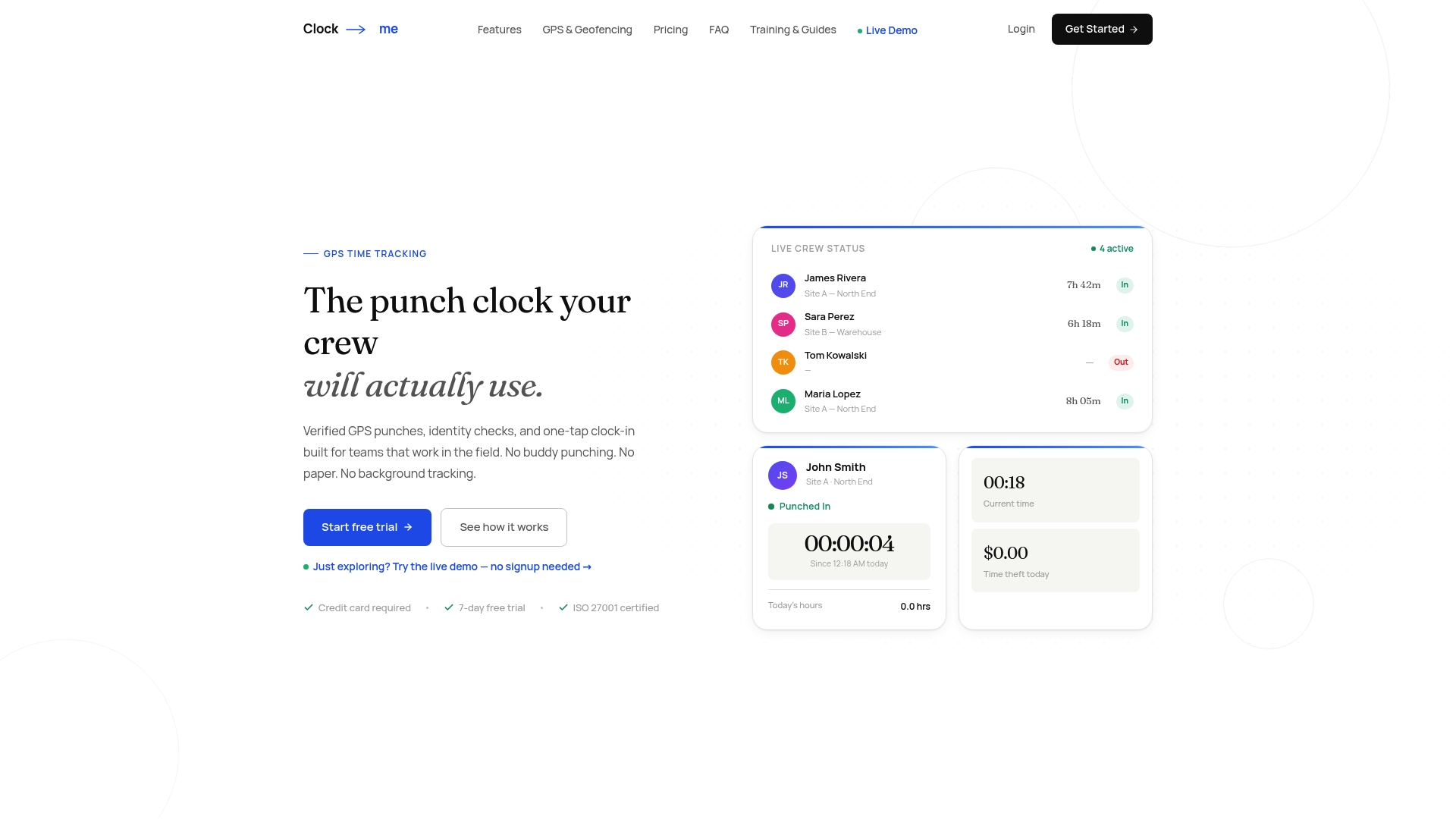
Field teams make this harder. Crews start at different sites, supervisors are not always present and employees punch in from phones. When a punch is not tied to a real person at a real place, you cannot prove when a shift began, how long it ran or whether the meal period happened. That is why we built Clock-Me around GPS-verified punches, identity checks, geofencing and timecard attestation, without paper timesheets or continuous background tracking.
Our advice is simple. Offer waivers only where they make sense. Keep them voluntary. Then rely on the time record to show what happened, shift by shift.
— Clock-me
If you manage field employees in California, Clock-Me lets you record verified clock-ins, watch attendance on a live dashboard, collect timecard attestations, approve timesheets and export to payroll. There is a Free plan at $0 per month for small teams. Paid plans are Starter at $31.99 per month, Growth at $54.99, Business at $99.99, Pro at $224.99 and Corporate at $439.99, all per month. Enterprise pricing is not published. Plans are based on the number of active employees, so you can start small and move up.
You can compare the tiers on the Clock-Me pricing page and see how verified punches work on the GPS clock-in page.
These are the errors we see most often.
No. A waiver requires mutual consent of the employer and the employee under Section 512. An employer who makes it a condition of work risks having the waiver treated as coercive, and the courts read wage rules in the employee’s favor.
In 2025, the court in Bradsbery v. Vicar Operating held that a prospective written waiver for shifts between five and six hours is enforceable absent unconscionability or coercion. It can only apply to days of six hours or less, and the employee may revoke it at any time. Ask your attorney whether the decision fits your situation.
With a waiver, the employee takes no meal period on a short shift and is paid for the time worked. With an on-duty meal agreement, the employee eats while working because the nature of the job prevents relief from all duty. The DLSE says the on-duty meal period is paid, requires a written agreement and must be revocable in writing.
The waiver no longer fits that day, so a compliant meal period is owed. If it is not provided, the employer owes one additional hour of pay at the regular rate for that workday, according to the DLSE. Flag these shifts in your timekeeping so you can correct them the same day.
Sometimes. Section 512.1 exempts covered employees if a valid collective bargaining agreement provides meal and rest periods and an equivalent monetary remedy. Read the agreement and get legal advice before you apply a standard waiver.
