missed punch policy
Missed Punch Policy: What to Include and a Form to Use
Write a missed punch policy that keeps pay accurate and records defensible: what the law requires, what to put in the form, and how to approve fixes.
Write a missed punch policy that keeps pay accurate and records defensible: what the law requires, what to put in the form, and how to approve fixes.

A missed punch policy is a short written rule that says what an employee does when they forget to clock in or out, who approves the fix, and how the correction is recorded. The most important point is that a missed punch is a record-keeping problem, not a reason to withhold pay. If someone worked the hours, you pay for them. Your policy exists so the record matches reality, quickly and with a paper trail.
Below you will find what the law expects, the parts every policy needs, what a missed punch form should contain, and how to cut down on missed punches for teams that work away from a desk.
A missed punch happens when a clock-in, clock-out, or meal break punch is absent or wrong. The employee forgot, the phone had no signal, the app crashed, or the shift ran long and nobody noticed.
Without a policy, each case turns into a conversation. One manager types in the time from memory. Another tells the employee to let it go. A third waits until payroll closes and guesses. That inconsistency is where wage disputes start.
The federal baseline is simple. The Fair Labor Standards Act (FLSA) requires employers to keep records on wages, hours, and other items, and time clocks themselves are not required. What is required is an accurate record. A written policy is how you produce one when the clock fails.
The U.S. Department of Labor’s FLSA training material says employees must be paid for all time considered hours worked, and that covered employers must maintain the required wage-and-hour records. A missing punch changes the paperwork. It does not change the obligation.
The Labor Department’s guidance also closes a common escape hatch. A written rule against unrecorded work is not enough if management knows the work is happening and does nothing. The duty falls on management to prevent work it does not want to pay for. So a policy that says “no punch, no pay” is a liability, not a control.
Under FLSA rules, employers must keep accurate records of each non-exempt worker’s hours worked each day and total hours each workweek. Payroll records, including time cards and schedules, must be kept for at least two years under that same federal fact sheet.
Small slips raise a fair question: can you ignore a couple of minutes? The Department of Labor allows disregarding “de minimis” time, meaning infrequent and insignificant periods that are practically difficult to record. That allowance does not cover regular or identifiable work time. A crew that loads the truck for ten minutes every morning is not de minimis. Neither is a technician who answers a call on the drive home every Friday.
The same guidance says rounding, such as to the nearest quarter hour, is acceptable only if employees are properly paid for all hours actually worked over time. Rounding that always favors the employer fails that test.

The Department of Labor reported in 2014 that a Southern Nevada housing authority had to pay $425,000 in overtime back wages after failing to record and pay for preshift, post-shift, and meal-break work. Most businesses are far smaller, but the pattern is the same: unrecorded minutes add up across people and months.
Federal rules are the floor. States add their own. California, for example, has its own wage claim process, and the state’s labor agency notes that employers are responsible for accurate time records while also recommending that employees keep their own personal records in case of a claim. If you employ people in California or any other state with stricter timekeeping, meal period, or pay-timing rules, have your policy reviewed against those rules or by an employment attorney before you roll it out.
The best policies are short enough to remember and specific enough to use. Here are the pieces.
A university payroll guide offers a useful model: hourly employees must submit and get approval for hours by payroll deadlines, and late submissions are paid in the next available pay cycle. Note what it does not do. It does not erase the hours. It moves them to the next cycle. If you adopt a similar rule, make sure your state allows delayed payment for late-reported time, because some states set strict deadlines for paying wages.
Write the policy as a process, not a threat. Employees who fear punishment for a forgotten tap will stay quiet, and then the missing hours surface later as a complaint. A consistent, easy path gets you reports early.
A form turns the policy into something people can fill out in two minutes. Whether it is paper, a PDF, or a request inside your time system, include these fields:
| Field | Why it matters |
|---|---|
| Employee name, ID, department | Ties the correction to the right record |
| Date of the missed punch | Places it in the right pay period |
| Punch type missed | Clock-in, clock-out, meal start, or meal end |
| Actual time worked | The corrected time the employee is claiming |
| Reason code | Forgot, device failure, no signal, left site early, other |
| Employee attestation | A statement that all worked time is reported accurately |
| Supervisor verification | Confirms the supervisor knows the actual hours |
| Approval name and date | Starts the audit trail |
Reason codes are the most overlooked field. If six people on one crew choose “no signal,” you have a site problem, not a people problem. If one person picks “forgot” every week, you have a coaching conversation. Codes let you respond to the cause.
Missed punch correction request Employee: ______ ID: ______ Date: ______ Missed: clock-in / clock-out / meal start / meal end Actual time: ______ Reason: forgot / device issue / no signal / other: ______ I confirm this is an accurate account of the time I worked, and that all of my worked time is reported. Employee signature and date: ______ Supervisor: I know this employee’s actual hours for this date and approve / do not approve this correction. Name and date: ______
Have your payroll provider or attorney review the wording before you use it, especially the attestation, so it fits your state.
Approval is not a rubber stamp. The approver should actually know what happened.
The University of Tennessee’s payroll policy, effective December 5, 2019, requires non-exempt employees to report actual time worked rather than planned schedules. It also calls for an approver who knows the employee’s actual hours, who reviews attendance records, and who approves and signs the missed-punch timecard. That is a good test for any business: could this supervisor say, from direct knowledge or records, that the corrected time is right?
The edit itself should never be invisible. The City of Houston’s supervisor guide describes a timecard Audits area that lists time-punch corrections and approvals, so edits are traceable. A city of Burlington, Vermont, procedure follows a similar path: the employee submits the date, time, and a comment explaining the request, then the manager gets a notification and approves it. Both show the principle you want: a consistent, reviewable correction path instead of someone quietly changing a number.
Whatever system you use, the log should show who asked, who approved, the original value, the new value, and the date.

Correction processes are necessary, but the cheapest missed punch is the one that never happens. Field work makes them more likely: crews start at job sites, not at a wall-mounted clock. Phones lose signal. Shifts begin in a truck.
The University of Tennessee policy points to practical habits: require prompt reporting of hours worked, have non-exempt employees record actual time, and review payroll reports before payday to catch discrepancies. For field teams, add these:
Before blaming the employee, look at the data. Are misses clustered on one site, one device type, one shift start, or one supervisor’s crew? The fix may be a clearer reminder, a different clock-in spot, or an app update, not a warning.
We see missed punch policies as a second line of defense. The first is a clock-in that is hard to forget, hard to fake, and easy to complete from wherever the job is.
Our view is that most correction work comes from two sources: honest forgetting and doubt about whether a punch is real. Honest forgetting is solved by making the punch one tap, close to the work. Doubt is solved by verification: a punch tied to a location and a verified person gives a supervisor something firm to compare a correction request against. That is why Clock-Me combines GPS-verified punches, identity checks, and geofencing, without paper timesheets or continuous background tracking.
We also think the policy should stay human. A form, a reason code, a supervisor who knows the work, and a log. Technology should shorten that path, never replace the judgment of the person approving. And because pay and records carry legal weight, in California and elsewhere, we build compliance features alongside the clock rather than after it.
— Clock-me
If your crews work away from the office, Clock-Me gives you verified GPS clock-ins, identity verification, geofencing, random location check-ins, live dashboards, timecard attestation, timesheet approval, and payroll export in one place. Supervisors see attendance as it happens, so a missing clock-out shows up the same day, while the shift is still fresh in everyone’s mind.
Plans start with a Free plan at $0 per month for small teams. Paid plans run from Starter at $31.99 per month and Growth at $54.99 per month, through Business at $99.99 per month, Pro at $224.99 per month, and Corporate at $439.99 per month. Enterprise is available with pricing on request. See the plans and start with Clock-Me.
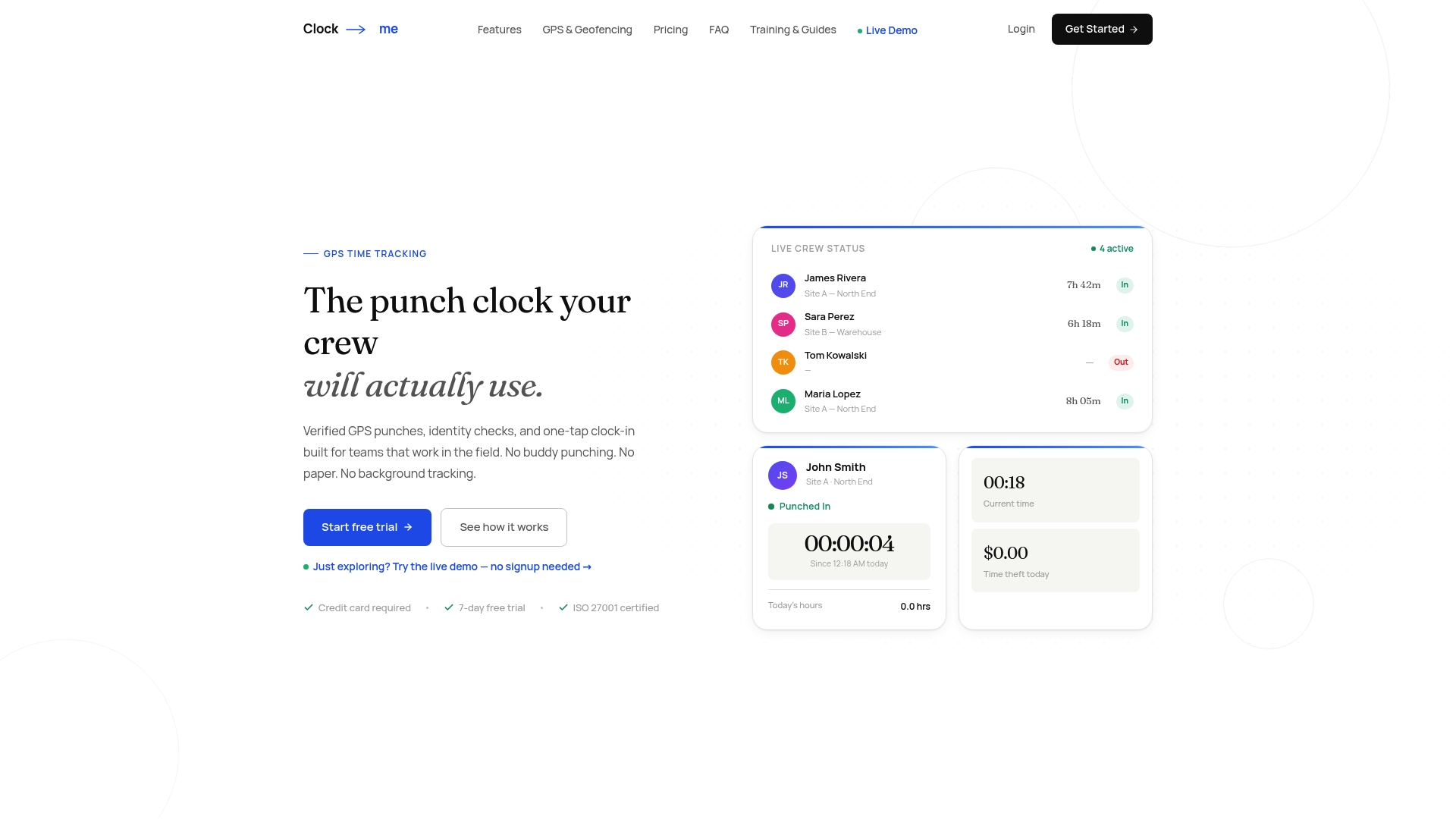
When you are ready to set up, the setup guide walks you through it step by step.
Use this list to put the policy in place in a week.
The employee reports it, usually with a form or a request in your time system, giving the actual end time and a reason. A supervisor who knows the real hours verifies and approves it, and the change is logged. The employee is still paid for the time worked.
Yes, if the work was performed and you knew or should have known about it. The Department of Labor says employees must be paid for all hours worked and that employers must keep accurate records. A missing punch does not make worked time disappear.
You can address the pattern through coaching or a written reminder, as long as you pay for all hours worked. Check the reason codes first, because the cause may be a device or site issue. Never dock earned pay as the penalty, and check your state’s rules before adding formal discipline.
Federal FLSA rules require payroll records, including time cards and schedules, to be kept for at least two years. Some states require longer. Keep the original punch, the correction request, and the approval together so the whole story is on file.
The FLSA does not set a general grace period, and de minimis allowances do not cover regular, identifiable work time. Rounding is allowed only if it averages out fairly over time. If you use any grace or rounding rule, write it into your policy and have it reviewed.