california rest break rules
California Rest Break Rules: What Employers Must Provide
California rest break rules for employers: the 10-minute paid break per four hours, timing, off-duty duty, records, attestation and the cost of getting it wrong.
California rest break rules for employers: the 10-minute paid break per four hours, timing, off-duty duty, records, attestation and the cost of getting it wrong.

California requires employers to authorize and permit a paid, off-duty 10-minute rest break for every four hours worked, or major fraction of four hours, for nonexempt employees. The break counts as time worked, and it should fall near the middle of each work period when practicable. If you miss one, you owe the employee an extra hour of pay for that day. This guide explains the rule, the shift-length math, what “off duty” means, what you need on file, and how field teams can keep clean records.
California’s wage orders require employers to authorize and permit a paid, net 10-minute rest period for each four-hour work period or major fraction of it. A “major fraction” means more than two hours. The rest period counts as time worked, so you cannot deduct it from pay. The state labor agency’s rest period FAQ sets this out, along with the 3½-hour floor: if total daily work time is under 3½ hours, no rest period is required.

“Net” matters. Ten minutes means ten minutes of rest, not ten minutes that includes the walk to the break area or the time to take off protective gear. If your site layout eats three minutes each way, the break has to be longer than ten minutes on the clock.
Applying “four hours or major fraction” to common shift lengths gives this schedule:
| Total hours worked in the day | Paid 10-minute rest breaks |
|---|---|
| Under 3½ hours | None required |
| 3½ to 6 hours | 1 |
| More than 6 up to 10 hours | 2 |
| More than 10 up to 14 hours | 3 |
This table applies the DLSE’s four-hours-or-major-fraction rule. A four-hour shift qualifies for one break. A standard eight-hour shift needs two, and a 10-hour crew day also needs two, while the third break begins to apply once the day passes 10 hours.
The agency’s answer on the four-hour shift is direct: yes, a four-hour shift qualifies for one rest period, and a shift under 3½ hours does not.
The rule applies to nonexempt employees under the state’s industrial welfare commission wage orders. A few narrow exceptions exist. The DLSE FAQ notes that certain 24-hour residential-care employees are treated differently, and that specified performers engaged in strenuous physical activity get additional interim rest periods during rehearsal or shooting.
The U.S. Department of Labor’s state rest period summary adds two details worth knowing. California’s rest period includes a paid “recovery period,” which is a cool-down period that prevents heat illness. And the DLSE may grant an exemption on employer application for undue hardship, if it would not materially affect employee welfare or comfort. That exemption does not extend to private household employment.
If you employ household workers, the recordkeeping side still applies. A look at California overtime rules for nannies shows how digital hour tracking supports the same wage-order duties.
The rest break should fall as close to the middle of each four-hour work period as practicable. If the work makes a mid-period break impractical, it can be taken elsewhere in the work period. For a typical eight-hour day, that means one break around the second hour and one around the sixth hour, with the meal period between them.
Two common field scenarios:
Where you schedule the break is your call, as long as it is as close to the middle as practicable and employees are genuinely able to take it.
This is where most disputes start. In Augustus v. ABM Security Services (2016), the California Supreme Court held that employers must relieve employees of all duties and relinquish control over how they spend their time during rest periods. The court also held that on-call rest periods are prohibited. You can read the full opinion.
The DLSE FAQ adds practical points:
For field teams, this means a radio, a pager, or a “stay by your phone” instruction can turn a break into a violation. If a supervisor needs to reach someone, that call belongs outside the 10 minutes.
Readers often mix these up, and the rules are not the same. In its Augustus v. ABM Security opinion, the California Court of Appeal explained that meal breaks are unpaid and last 30 minutes, while rest breaks are paid and last 10 minutes. The court also noted that the Brinker relieved-of-all-duty standard applies to meal periods (Wage Order 4, subdivision 11(A)), but not to rest periods (subdivision 12(A)).
| Rest break | Meal period | |
|---|---|---|
| Length | 10 minutes, net | 30 minutes |
| Paid? | Yes, counts as time worked | No |
| Trigger | Every four hours or major fraction | Set by meal period rules |
| Must be recorded? | No | Yes |
For the meal side of the equation, see our guide to a 30 to 90 day fix for California meal break compliance and the rules on a meal break waiver in California.
California wage orders require records showing when each work period begins and ends, meal periods, split-shift intervals, and total daily hours. Authorized rest periods need not be recorded. The California Employment Law Report summarizes these requirements for electronic timekeeping.
That does not mean rest breaks are invisible. If an employee sues, you will want evidence that breaks were authorized, scheduled and available. Your written policy, your schedules, and your employees’ signed time records all carry weight.
Other recordkeeping rules from HRCalifornia:
For a broader view of this topic, our guide to audit-ready timekeeping for California employers covers the full record set.
An attestation is a short confirmation the employee completes at the end of the shift. The California Supreme Court’s 2021 decision in Donohue v. AMN Services is the reference point, although it dealt with meal periods. The court’s opinion held that time records showing noncompliant meal periods raise a rebuttable presumption of violations at summary judgment. You can rebut it with evidence of bona fide relief from duty or proper compensation. The court also approved a timekeeping system with a dropdown menu where employees indicate whether they had a compliant meal period but chose to work.
The opinion also explains that the presumption does not require employers to police meal periods to make sure no work happens. It requires you to give employees a way to record their meal periods and to make sure they use it properly. You are not liable when an employee chooses a short or delayed meal period, or none at all.
According to the California Employment Law Report article above, electronic attestations completed before employees clock out can shift the burden to the plaintiff to show there was no opportunity for a meal or rest break. The same logic is why many employers extend the attestation to cover rest breaks too: it documents that breaks were offered and available.
A practical attestation asks three things at the end of the day:
Keep the wording neutral. The goal is an accurate record, never pressure to answer a certain way.
For crews working across sites, vehicles and customer locations, paper sheets create gaps. Electronic timekeeping is accepted in California. The article from the California Employment Law Report notes that DLSE opinion letters from 1995 and 1998 treat electronically stored records as compliant if they are retrievable in California and can be printed in indelible form on request. Electronic data can be maintained outside California if a hard copy is kept at a central location within California.
The features that matter for rest-break compliance are:
If you are setting up a system, the workflow is simple: define the break schedule in your written policy, train supervisors to protect the breaks, and use the timecard to capture attestations and exceptions. Teams comparing software can also read how a dance studio configures time tracking in one week for a sense of the setup effort involved in a time clock rollout.
Most rest break problems don’t start with bad intent. They start with a gap: a crew lead who can’t tell whether a break happened, a paper timesheet filled in on Friday from memory, or a punch someone made for a teammate.
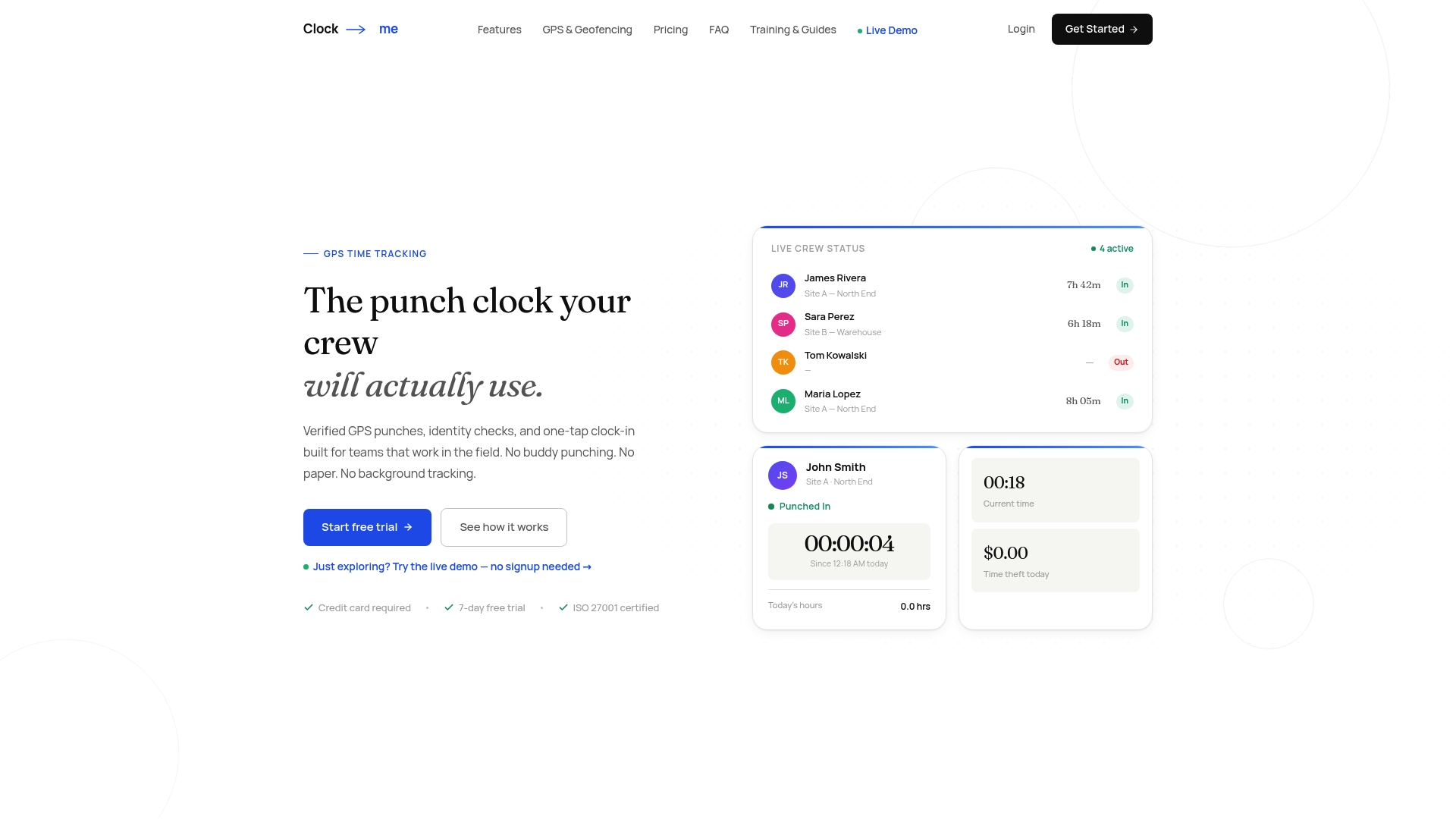
We built Clock-Me around closing those gaps for field teams. GPS-verified clock-ins and identity verification help make sure the person on the timecard is the person on the job. Geofencing and random location check-ins give managers confidence about where work happens, without continuous background tracking. Timecard attestation lets employees confirm their shift details before it goes to approval, and live dashboards let supervisors see attendance as it happens.
Rest periods themselves don’t need to be recorded, but your defense depends on records you can trust. A clean, paperless time record, with approvals and payroll export in one place, is the foundation. Our approach is designed to make compliance part of the daily routine rather than an audit-season scramble.
Clock-me
Clock-Me gives field teams a one-tap clock-in with verified GPS and identity checks, plus geofencing, live dashboards, timecard attestation, timesheet approval and payroll export, all without paper. Plans are based on active employees: Free is $0 per month, Starter is $31.99 per month, Growth is $54.99 per month, Business is $99.99 per month, Pro is $224.99 per month and Corporate is $439.99 per month. Enterprise pricing is not published. See the details on the Clock-Me site.
For related rules, our library on California wage and hour laws and the guide to California wage and hour compliance are good next reads.
Under Labor Code section 226.7, if an employer fails to provide a meal, rest or recovery period as required, the employer must pay the employee one additional hour at the regular rate of compensation for each workday the period was not provided. One hour is owed per day, not per missed break. If an employee misses both rest breaks in an eight-hour shift, the premium is still one hour for that day.
The DLSE FAQ says an employee whose employer fails to authorize or permit a required rest period can file a wage claim if the premium is not paid. An employee regularly scheduled for an eight-hour shift may file a wage claim or a lawsuit to recover it.
The time limit is longer than many employers expect. In Murphy v. Kenneth Cole Productions (2007), the California Supreme Court held that the extra hour of pay is a premium wage, not a penalty, so a three-year statute of limitations applies instead of one year. The court’s opinion reasons that an employee denied two paid rest periods in an eight-hour day essentially performs 20 minutes of unpaid work. The DLSE FAQ confirms the three-year period for rest period claims.

Because the remedy is a wage, the premium should appear on the paycheck as wages. Your payroll process needs a clear way to flag and pay it when a break was not provided. Our article on the split shift premium and one hour pay formula shows how the one-hour calculation works in practice, and the guide to overtime rules and time tracking covers how it interacts with overtime.
For more on this area, browse our collection of California labor law articles and timekeeping regulations for California.
Yes. A four-hour shift qualifies for one paid 10-minute rest break under the four-hours-or-major-fraction rule. Shifts shorter than 3½ hours do not require one. Take the break near the middle of the work period when practicable.
Yes. Rest periods count as time worked, so employees are paid in full for them. This is the key difference from meal periods, which are unpaid 30-minute breaks.
No. The California Supreme Court held in Augustus v. ABM Security Services that on-call rest periods are prohibited and that employers must relieve employees of all duties. The DLSE also says you cannot require employees to stay in radio contact during the break.
Authorized rest periods do not need to be recorded under the wage orders. You do need accurate records of work periods, meal periods and total daily hours. Many employers add an attestation so employees can confirm that breaks were available.
The DLSE says the statute of limitations on a rest period claim is three years, based on the California Supreme Court’s ruling in Murphy v. Kenneth Cole Productions that the premium is a wage.