time clock policy sample
Time Clock Policy Sample: A Template You Can Adapt
Copy-ready time clock policy sample with sections for punches, breaks, overtime, missed punches and buddy punching, plus the U.S. rules behind each clause.
Copy-ready time clock policy sample with sections for punches, breaks, overtime, missed punches and buddy punching, plus the U.S. rules behind each clause.

A good time clock policy fits on two pages and answers six questions: who must clock in, how and where, what counts as paid time, how breaks and overtime are recorded, what to do after a missed punch, and what happens when someone falsifies time. Below you will find a sample you can paste into your handbook, the reasoning behind each clause, and the U.S. rules that shape it.
A time clock policy turns “we expect accurate hours” into rules people can follow and managers can enforce. It protects payroll accuracy, gives you consistent records, and sets a clear line on fraud such as clocking in for a coworker.
It also supports your legal position. Under the federal Fair Labor Standards Act (FLSA), covered employers must keep specific records for nonexempt workers, including daily and weekly hours, pay rate, straight-time and overtime earnings, deductions and pay dates. A written policy is how those records get created the same way every pay period.
One point surprises many owners: the Department of Labor says employers may choose any timekeeping method, including a time clock, a timekeeper or employee-written records, as long as the system is complete and accurate. The federal rule at 29 CFR 785.48 also states that time clocks are not required. Your policy picks the method. The law only demands that the result be right.

Adapt the wording below to your business. Square brackets mark the parts you must fill in.
Time Clock Policy
1. Purpose. [Company] keeps accurate records of the time employees work so that everyone is paid correctly and on time. This policy explains how to record that time.
2. Who this applies to. This policy applies to all nonexempt (hourly) employees. Exempt employees are not required to record daily hours except where needed for purposes such as client billing or project costing.
3. How to clock in and out. Employees record time using [name of system, for example the Clock-Me mobile app]. You must clock in when you start work, clock out when you finish, and clock out and in for unpaid meal periods. Use only the method assigned to you, or an alternative approved in advance by your manager.
4. Where you may clock in. Field employees may clock in only at an assigned job site or approved work location, as verified by [GPS location / site boundary]. If your location cannot be verified, tell your supervisor before starting work.
5. Starting and ending work. Clock in no earlier than [5] minutes before your scheduled start unless your supervisor has approved earlier work. Do not perform any work before clocking in or after clocking out. If you do work, it will be recorded and paid.
6. Meal and rest breaks. Unpaid meal periods of [30] minutes or more must be recorded with a clock-out and clock-in, and you must be fully relieved of duty. Short rest breaks of about 20 minutes or less are paid and are not clocked out.
7. Overtime. Overtime must be approved by your supervisor before it is worked whenever possible. All overtime actually worked will be recorded and paid, whether or not it was approved. Unapproved overtime may lead to coaching, but never to unpaid time.
8. Missed or incorrect punches. Report a missed or wrong punch the same day you notice it, or during your end-of-shift review. Your manager may add or edit a punch only after confirming the correct time with you, and must record the reason and how it was verified in a timecard note.
9. Timecard review and attestation. At the end of each shift or pay period, you will review your timecard and attest that it is accurate and complete. Supervisors review exceptions and approve timecards by [deadline, for example noon on the Monday after the pay period ends].
10. Prohibited conduct. You may not clock in or out for another person, ask anyone to clock for you, alter a time record, or record time you did not work. Violations may result in discipline, up to and including termination.
11. No retaliation. You will not be retaliated against for reporting a timekeeping error, an unpaid hour or a policy concern in good faith.
12. Questions. Contact [name / title / email].
State outright who must clock. The Montana Department of Labor’s model handbook says nonexempt employees should clock in and out to record daily hours, while exempt employees generally need not, apart from purposes like billing. Be careful with exempt status: it depends on job duties and pay, not on a job title.
The sample ties each employee to one assigned method. UCSF’s timekeeping policy takes the same approach, requiring nonexempt employees to clock at shift start, shift end and meal breaks using the assigned method or an approved alternative. For office staff the “where” is simple. For crews on job sites, clause 4 matters most, because a punch from the wrong place is the most common source of disputed hours.
This is where small policies go wrong. The DOL’s Fact Sheet #22 explains that short rest periods, usually 20 minutes or less, are generally paid working time, while bona fide meal periods, typically 30 minutes or more, can be unpaid only if the employee is completely relieved from duty. A lunch spent answering the phone is paid time, whatever your policy says.

Federal law also does not set break schedules. The DOL’s FLSA FAQ notes that the FLSA generally does not require meal or rest breaks, though some states do. Check your state before you copy clause 6, and where state and federal rules differ, the higher standard controls.
Requiring advance approval is reasonable. Refusing to pay unapproved hours is not. Chuze Fitness’s timekeeping policy illustrates the balanced version: approval may be required in advance, but all overtime actually worked must still be recorded and paid, and employees are protected from retaliation for reporting errors. Clauses 7 and 11 follow that principle.
For covered nonexempt employees, the DOL says overtime is generally at least 1.5 times the regular rate after 40 hours in a workweek, subject to exceptions. Some states add daily overtime rules, so confirm yours.
Many policies mix up two ideas. A grace period is an attendance rule: how late someone can be before it counts as tardy. Rounding is a pay rule. UCSF’s policy separates quarter-hour rounding for pay from an attendance grace period, and you should too.
Federal rules allow rounding to the nearest five minutes, tenth or quarter hour only when it does not fail to compensate employees for all time actually worked. The same rule limits “de minimis” treatment to uncertain, insignificant periods of a few seconds or minutes. Regular, ascertainable work time cannot be ignored. If your rounding always favors the company, drop it.
| Topic | Weak wording | Stronger wording |
|---|---|---|
| Early clock-in | “Do not clock in early.” | “Clock in up to 5 minutes before your shift unless approved. Any work performed is paid.” |
| Overtime | “Unapproved overtime is not paid.” | “Get approval first. All time worked is paid.” |
| Lunch | “30 minutes are deducted daily.” | “Clock out and in for meals. Tell us if you were interrupted.” |
| Corrections | “Managers fix errors.” | “Managers edit only after confirming with you, with a written note.” |
| Fraud | “Cheating is not allowed.” | “You may not clock in or out for anyone else.” |
Every policy needs a missed punch process, because every team has missed punches. The approach in the Chuze policy is a good model: employees correct missing or inaccurate punches during end-of-shift attestations, managers add or edit punches only when necessary after confirming with the employee, and the reason and verification go in a written note. Managers then review exceptions each pay period.
That written note is your timecard notes policy in one sentence. A useful note answers four things:
If you want a ready-made form and more wording, see our guide to a missed punch policy and the form to use.
An attestation is the employee’s statement that the timecard is correct. UCSF requires employees to attest to timecard accuracy and record all worked time and time off by the pay-period deadline. The Montana model handbook adds that supervisors review and initial timecards, and that overtime is approved before it is performed.
Put deadlines in the policy, not in a manager’s head. A simple rhythm works: employees attest daily or weekly, supervisors approve by a fixed day, and payroll closes after that. For crews that submit from phones, mobile timesheets for engineers show how short, regular submission keeps hours accurate. For the admin side, our six-step timecard approval workflow lays out who reviews what and when.
Buddy punching means one person clocking in or out for another. The policy answer is simple and should be unambiguous: prohibit it, require certification of timecards, and have supervisors review records. The Montana model handbook prohibits falsifying or clocking another employee’s time record, and UCSF likewise prohibits clocking in or out for another person.
A written rule only deters. For field crews, who are far from any supervisor, you also need controls that make the rule hard to break:
Write whichever of these you use into the policy, and tell employees what data is collected and when. Clear notice builds trust and avoids disputes later.
Office policies assume a front door and a wall-mounted clock. Crews in landscaping, cleaning, construction or home services have neither. Add these items:
For federal requirements, our guide on building audit-ready FLSA timekeeping in six steps walks through the record details. If you employ people in California, read audit-ready timekeeping for California employers, since state rules on meal and rest breaks and overtime are stricter than the federal baseline.
If you also keep a paper or spreadsheet backup, the DOL offers an optional sample table in Fact Sheet #21 with day, date, multiple in/out periods, total daily hours and total workweek hours. A version you can reuse:
| Day | Date | In | Out | In | Out | Total daily hours |
|---|---|---|---|---|---|---|
| Monday | [date] | 8:00 AM | 12:00 PM | 12:30 PM | 4:30 PM | 8.0 |
| Tuesday | [date] | 8:00 AM | 12:00 PM | 12:30 PM | 4:30 PM | 8.0 |
| Workweek total | 16.0 |
The meal break between 12:00 PM and 12:30 PM is excluded because the employee clocks out and back in.
Outside the U.S. the rules differ. For example, a 2019 European Court of Justice interpretation, as summarized by Dentons, requires EU employers to set up an objective, reliable and accessible system for measuring daily working time. This article’s sample is written for U.S. employers.
Most time clock policies fail in the field, not on paper. The wording is fine, but nothing checks that the person clocking in is the right person, standing in the right place.
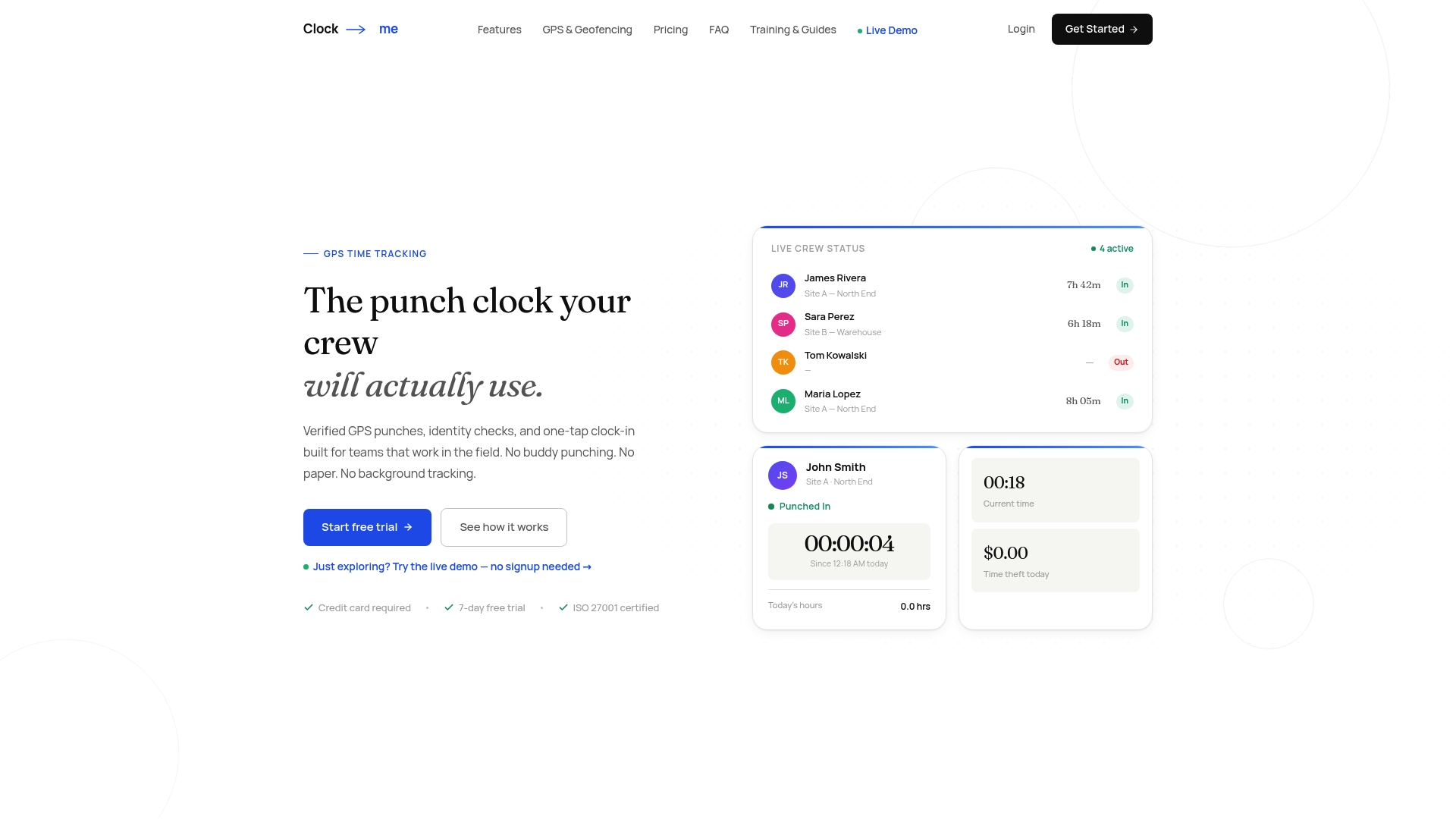
That is why we built Clock-Me around verified punches. Identity checks, GPS-verified clock-ins and geofencing turn “you may not clock in for someone else” from a hope into a rule the system can enforce. Random location check-ins let you confirm presence without tracking people in the background all day.
We also think the best policy is one employees can follow in one tap. No paper timesheets, no end-of-month reconstruction, and a clear end-of-shift attestation so mistakes are caught while people still remember them. Managers get live dashboards and a timesheet approval flow, so exceptions surface in the pay period rather than after payroll runs.
Write your policy first. Then choose tools that make each clause easy to follow and easy to prove.
Clock-me
Clock-Me is a workforce management platform for teams in the field. It combines GPS-verified clock-ins, identity verification, geofencing, random location check-ins, live dashboards, timecard attestation, timesheet approval and payroll export, with features built for California labor law compliance.
Pricing is based on the number of active employees. The Free plan costs $0 per month, and paid plans start at $31.99 per month for Starter, then $54.99 for Growth, $99.99 for Business, $224.99 for Pro and $439.99 for Corporate. Enterprise pricing is not published. Visit Clock-Me to see which plan fits your team, or read more in our time tracking software articles.
No. Under 29 CFR 785.48, time clocks are not required. What matters is that you keep complete and accurate records of hours worked, using a method that suits your workplace. Many field employers use a mobile app instead of a wall-mounted clock.
Only if the rounding does not cost employees paid time over a period. Federal rules accept rounding to the nearest five minutes, tenth or quarter hour when it averages out fairly. If your rounding consistently benefits the company, change it, and ask an employment attorney or your state labor agency about state rules.
Yes, when necessary. Best practice is to confirm the correct time with the employee first, then document the reason and how you verified it in a timecard note. Review manual edits every pay period to spot patterns.
Yes. You can require advance approval and discipline employees who ignore it, but time actually worked must be recorded and paid. Writing this into the policy protects you and keeps employees reporting hours honestly.
Name the specific behaviors: clocking in or out for someone else, asking someone to clock for you, altering records, and recording time not worked. State the consequences, up to and including termination, and add a no-retaliation clause for people who report errors.